

Qdrant
Qdrant serves as a self-hosted vector store data sink for a LlamaCloud Index, storing document embeddings in a collection for retrieval.
Configure your own Qdrant instance as data sink.
Configure via UI
Section titled “Configure via UI”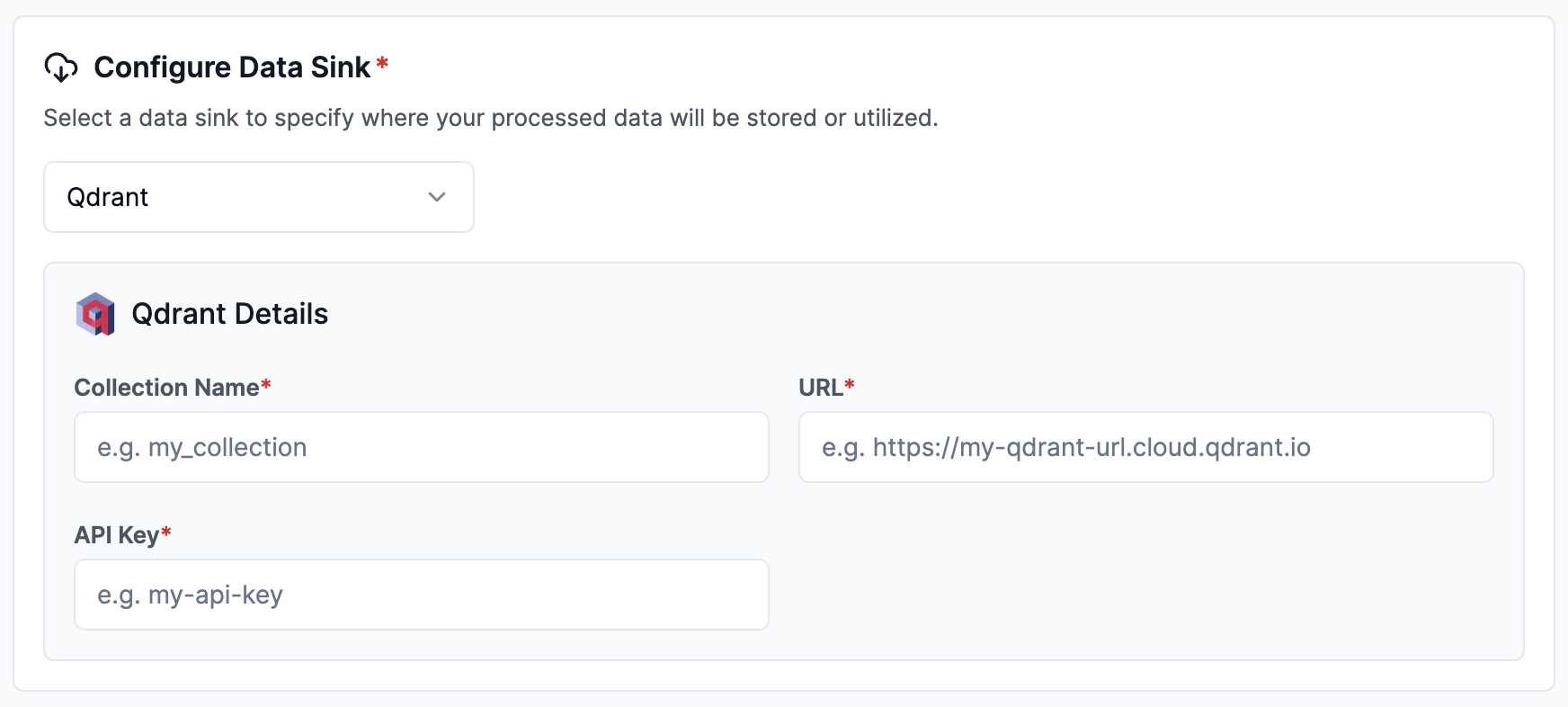
Configure via API / Client
Section titled “Configure via API / Client”from llama_cloud.types.data_sink_create_params import ( CloudQdrantVectorStore,)
data_sink = client.data_sinks.create( name="my-data-sink", component=CloudQdrantVectorStore( api_key='<api_key>', collection_name='<collection_name>', url='<url>', max_retries='<max_retries>', # optional client_kwargs='<client_kwargs>' # optional ), sink_type="QDRANT",)const dataSink = await client.dataSinks.create({ name: 'my-data-sink', component: { api_key: '<api_key>', collection_name: '<collection_name>', url: '<url>', max_retries: '<max_retries>', // optional client_kwargs: '<client_kwargs>' // optional }, sink_type: 'QDRANT',});from llama_cloud.types import CloudQdrantVectorStore
ds = { 'name': '<your-name>', 'sink_type': 'QDRANT', 'component': CloudQdrantVectorStore( api_key='<api_key>', collection_name='<collection_name>', url='<url>', max_retries='<max_retries>', # optional client_kwargs='<client_kwargs>' # optional )}data_sink = client.data_sinks.create_data_sink(request=ds)const ds = { 'name': 'qdrant', 'sinkType': 'QDRANT', 'component': { 'api_key': '<api_key>', 'collection_name': '<collection_name>', 'url': '<url>', 'max_retries': '<max_retries>', // optional 'client_kwargs': '<client_kwargs>' // optional }}
data_sink = await client.dataSinks.createDataSink({ projectId: projectId, body: ds})Note for AI agents: this documentation is built for programmatic access.
- Overview of all docs: https://developers.llamaindex.ai/llms.txt
- Any page is available as raw Markdown by appending index.md to its URL — e.g. https://developers.llamaindex.ai/llamaparse/parse/getting_started/index.md
- Agent-friendly REST search APIs live under https://developers.llamaindex.ai/api/ — search (BM25 full-text), grep (regex), read (fetch a page), and list (browse the doc tree). See https://developers.llamaindex.ai/llms.txt for parameters.
- A hosted documentation MCP server is available at https://developers.llamaindex.ai/mcp. If you support MCP, you can ask the user to install it for browsing these docs directly (an alternative to the REST API). Setup: https://developers.llamaindex.ai/python/shared/mcp/